research
Two directions I am working on right now.
Implicit full-waveform inversion imaging

Subsurface images are usually obtained in two steps: full-waveform inversion (FWI) for the velocity, then least-squares reverse time migration for the reflectivity. Implicit FWI imaging (IFWIM) represents the velocity and impedance models with the weights of a neural network and inverts them jointly with the vector-reflectivity acoustic wave equation; the reflectivity components then follow from the inverted impedance. Because the models are continuous functions, they can be resampled at any resolution, even on irregular grids.
SWEEP: differentiable wave physics
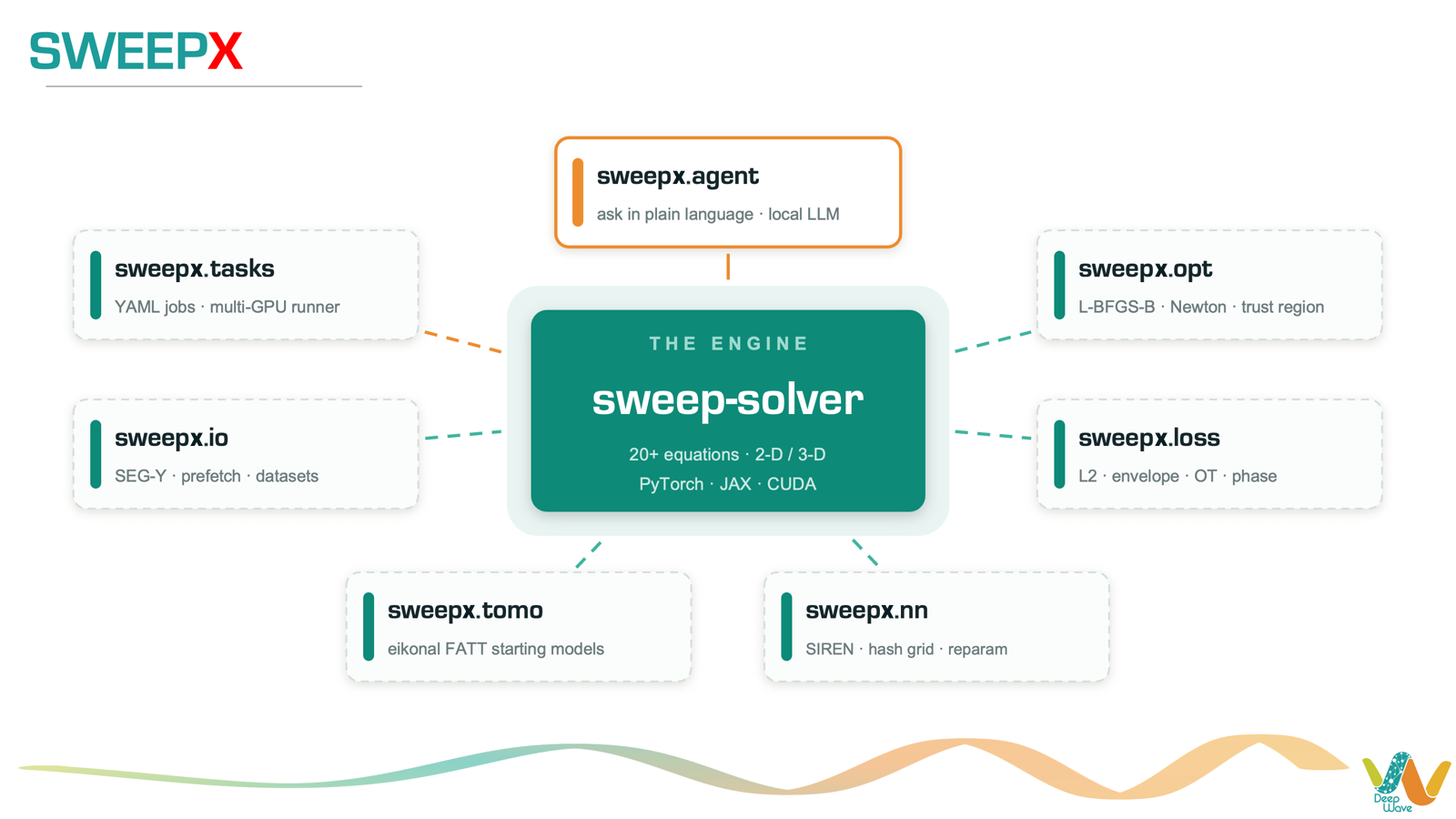
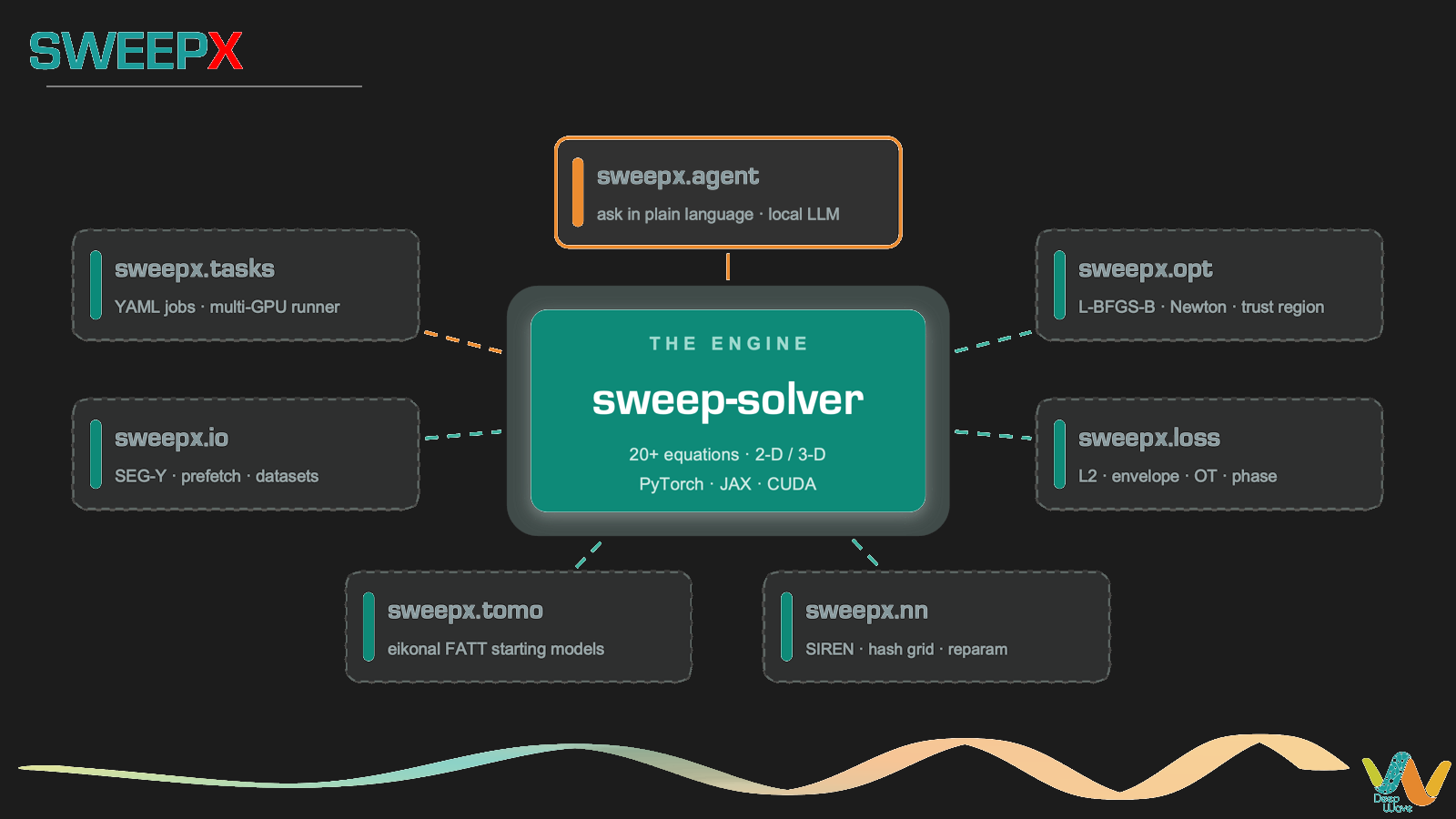
Components marked open their documentation or code.
SWEEP (Seismic Wave Equation Exploration Platform) is a unified solver framework for differentiable wave physics. Its engine, sweep-solver, covers more than 20 wave equations in 2-D and 3-D with PyTorch, JAX and CUDA backends. Around it, the SWEEPX ecosystem adds packages for multi-GPU job running, seismic I/O, optimization, misfit functions, tomography starting models and neural reparameterization, plus an agent you can ask in plain language.
Documentation · Preprint · pip install sweepx